The Legacy Friction: Correspondent Banking in 2026
Despite advances in consumer technology, international business payments remain tethered to infrastructure designed in the 1970s. When a company in New York pays a remote engineer in Singapore, the transfer must travel through multiple correspondent banks. Each intermediary takes a cut, performs compliance verification manually, and adds hours—if not days—to the settlement pipeline.
The resulting latency isn't just an inconvenience; it represents active treasury drag. Capital tied up in transit cannot yield interest, nor can it be deployed toward productive operations.
The Hidden Costs of Global Talent Onboarding
Legacy payroll systems subject businesses to: - Foreign Exchange Markups: Banks routinely charge 2% to 5% above the mid-market rate to convert USD to local currencies. - Unpredictable Lift Fees: Receiving banks often subtract processing fees directly from the employee's paycheck, causing friction and trust issues. - Compliance Redundant Screening: Every intermediary bank screens the transaction, resulting in false positives that freeze payments for weeks.
Stablecoins as the Solution: Instant Settlement Rails
Stablecoins like Circle's USDC and EURC bypass the entire correspondent banking network. By tokenizing national currencies on fast public blockchains like the Arc Network, payments move point-to-point without intermediaries.
USDC transactions settle in sub-seconds. Whether you are paying one engineer in Tokyo or routing payroll to a hundred employees across ten countries, the settlement time remains uniform.
How RemitFlow Eliminates Cross-Border Latency
RemitFlow orchestrates this stablecoin architecture into a single enterprise dashboard: 1. Universal Balances: Hold USDC or EURC on Arc and route payments to any destination without maintaining separate local currency accounts. 2. Gasless Sponsorship: Utilizing Arc's native USDC gas standard, employees and contractors receive their full payouts without needing to manage gas tokens (like ETH or MATIC) for transaction fees. 3. Automated Compliance: Integrated compliance nodes check wallet addresses against international sanctions lists in real-time, generating cryptographic proof of clearance.
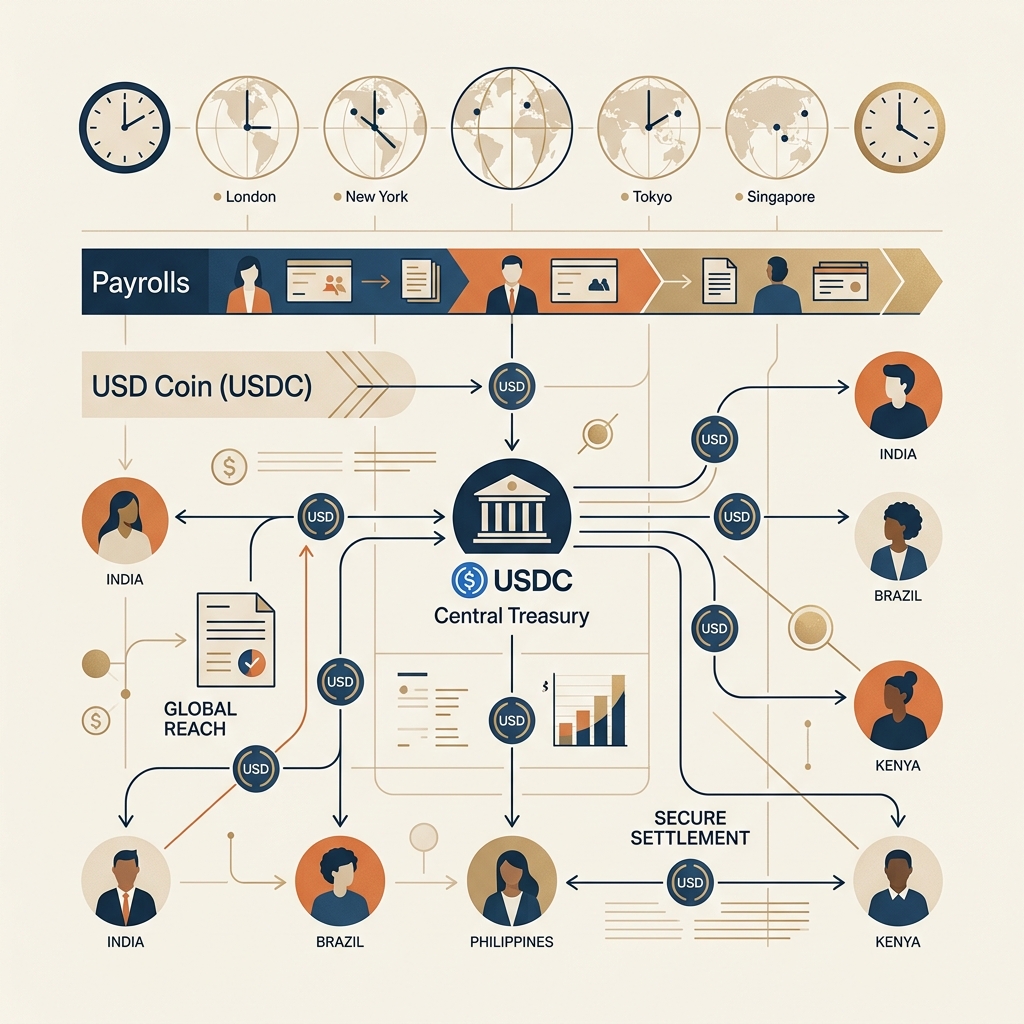 Stablecoin payroll vs traditional rail
Conclusion: The Future of Global Payroll is Instant
Relying on legacy rails places modern startups at a competitive disadvantage. Top global talent expects rapid, transparent compensation. By leveraging stablecoins, forward-thinking organizations can redirect correspondent bank fees back into employee benefits and corporate growth.
Ready to transform your global payout architecture? Get started with RemitFlow today and run your first gasless stablecoin payroll run in minutes.

RemitFlow Team
Treasury & Operations
The RemitFlow treasury team works closely with international enterprise customers to optimize liquidity flows, automate compliant payrolls, and leverage Circle's global stablecoin rails.